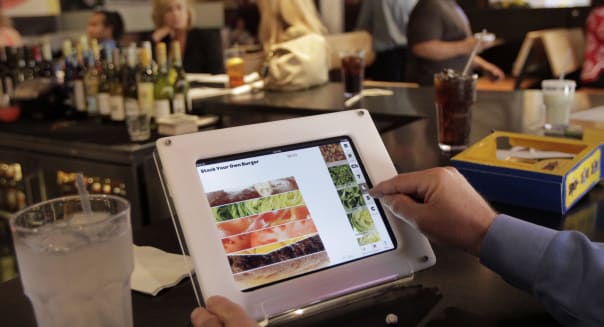
 AP/Jae C. Hong For all the talk about drones replacing parcel carriers or self-driving cars disrupting the taxi industry, there's a bigger tech revolution happening in the restaurant industry right now that may displace workers far sooner than anything futurists foresee in those other industries. The arrival of tablets and smartphone apps that detail menu items, take orders, and let you settle up your tab at the en of the meal will be a big theme among casual dining chains and even a few independent foodie haunts this year. Brinker International's (EAT) Chili's, DineEquity's (DIN) Applebee's, and a handful of San Francisco fine dining establishments are leading the push to add the technology, which will make waiters and waitresses less necessary. None of the chains have said that these tech initiatives will lead them to reduce waitstaff headcount -- but it doesn't take a lot of foresight to connect the dots. If folks are using table-side tablets to place orders and ask for drink refills, or firing up a smartphone app to pay at the end of a meal, that naturally translates into fewer front-of-house employees needed to keep an eatery going. Order Up In fact, some industry leaders outright deny that mobile tech will displace staff. "This really isn't a labor play," DineEquity CEO Julia Stewart said on CNBC late last year, explaining Applebee's move to deploy 100,000 tablets this year -- one at every table. "It's not about saving labor. This is really about creating an opportunity to talk to our guest, have an interactive conversation with our guest, and give our guest a lot more opportunities." At first, a waitstaff will be instrumental in assisting customers as they use the tablets to place orders or pay their bills. There will also be patrons who are apprehensive about embracing the technology, and Applebee's will still have waiters taking orders the old-fashioned way for people who prefer talking to a person. Chili's is going with a less-comprehensive tabletop tablet solution that enhances the traditional process. Diners will still place their meal orders from a waiter, but the tablets will be there to request drink refills, order desserts, or pay for their food at the end of the meal. Customers won't be forced to embrace the new technology; Applebee's and Chili's will clearly be sensitive to traditional patrons. However, as those customers see the folks who use restaurant-provided tablets being served faster (because they could order as soon as they were ready) and being able to settle up quickly as soon as they were done, the lure of convenience will likely draw more of them as well. Sooner than you'd think, there will be fewer people ordering their meals from human servers, or leaning on them for tech support. Foodies Just Want to Have Fun It's not just the casual dining chains trying to use technology to speed up the process. Online reservations specialist OpenTable (OPEN) revealed this past weekend that it's testing a new mobile payment feature with nearly a dozen San Francisco restaurants. It's inviting a few San Francisco users of its popular smartphone app to add a credit card to the account that will allow for mobile payments to be processed. At the end of the meal, they can view their bill and pay it without having to call for a waiter. That could save servers as many as four trips to the table: one each for the bill request, delivering the bill, picking it up, and returning it after it's processed. The upside to these tech initiatives is that tables will rotate faster, allowing restaurants to serve more customers. The company providing the tablet technology to Applebee's claims that tables turn seven minutes faster once the gadgets are deployed. This will likely lead restaurants to increase staffing among cooks, food runners, and bussers. But don't be surprised if soon, it starts getting a lot harder to find a waiter at your local eatery -- and that it doesn't bother you at all.
Monday, March 9, 2015
Later, Waiter: A Tablet Revolution Will Displace Scads of Servers - Soon

Sunday, March 8, 2015
A New Strategy for Smart Tech Investors
Leading newsletter publisher Investing Daily is launching a new publication today; Jim Pearce walks us through the strategy behind Smart Tech Investor, highlighting how its indicators determine over- and under-valuation in the sector.
Steve Halpern: Investing Daily is known for some of the advisory industry's most popular and long-running newsletters, including the flagship Personal Finance, and we are here today with Investing Daily's Wealth Society director, Jim Pearce. How are you doing today?
Jim Pearce: Great, Steve. How are you?
Steve Halpern: Very good. The timing of this interview is no accident, in fact, today is the launch of your latest newsletter, Smart Tech Investor. First, can you give us an overview of why you have chosen the tech sector for this latest product launch?
Jim Pearce: Sure. Actually, there are several reasons; one, of course, is that there is an awful lot of interest in tech stocks at the moment.
A day does not go by, it seems like, to me at least, when I am driving in to work, that I do not hear on the radio the latest news on Facebook, Yahoo, Microsoft's search for a new CEO, Twitter's IPO, I mean, it is just all over the news.
A lot of our subscribers have been asking about it. In fact, earlier this year, we began an interview series with a tech sector expert, originally with the intent of just providing some additional coverage for our Wealth Society members.
Over the course of doing that interview series, we realized we had a huge asset in the person of Leo Boeckl, and we wanted to be able to continue to help our subscribers invest better in the tech market. A couple of months ago, we decided to launch a new publication based around his kind of unique approach to evaluating tech stocks.
Steve Halpern: Now, in analyzing stocks, you use a proprietary valuation model that he developed called the BIQ. Could you briefly explain how this works?
Jim Pearce: Sure. The BIQ is spelled B-I-Q and it stands for Boeckl Innogration Quotient, and, of course, Boeckl is Leo's last name.
Innogration is a term that no one knows, because Leo invented it, and I will explain what that is in a second. It is really a model that puts a numerical value on each individual tech stock we cover, based on the three specific elements of Leo's approach to evaluating tech stocks.
Implicit in that is Leo's theory of innogration—and innogration is the combination of the two words, innovation and integration, and, in simplest terms, it is based on the idea that the leading tech stocks of today, and in the future, are those that not only innovate internally, but also use their resources to acquire functionalities from external sources to create a market-leading product.
He has identified three specific variables that contribute to successful integration and assigned a numerical value to each of those, so that the total value, it is a scale of zero to ten, so the highest the company could score, if it is was perfect in every category, is a ten and the worst, of course, is a zero.
I can tell you there are no zeros or tens, but there are some companies that are down in the one to two range, and there are some others that are up in the eight and nine range.
It is a very useful tool in sifting through all the noise in the market to really zero-in on those companies that, not only are popular today, but will be the market leaders in the future.
Page 1 | Page 2 | Page 3 | Next Page The expert featured in this column, James Pearce, may or may not own positions in any investment vehicle mentioned here. The views and opinions expressed are his or her own.